

Your funnel isn’t broken. You’re just measuring the wrong half of the sale.
That’s the uncomfortable truth behind most B2B marketing conversations happening right now. The pipeline numbers look defensible. The attribution dashboard glows green. Campaign reports show healthy conversion rates. And yet something feels off. Sales cycles drag.
Deal quality is uneven. Prospects show up saying “we’ve been watching you for a while” when the CRM swears they’ve never touched a single piece of your content.
The instinct is to fix what you can see. Optimize the ads. Rewrite the landing pages. Add another nurture sequence. Tighten the SQL handoff. But the problem isn’t execution.
The problem is that the funnel you’re optimizing was designed for a buyer who no longer exists — and the dashboard you’re trusting to tell you the truth is showing you the smaller, less important part of the journey.
The real buying decision is happening somewhere else. Somewhere your analytics can’t reach. That place has a name, and it’s time B2B marketing leaders took it seriously.
The Funnel Was Built for a Buyer Who Doesn’t Exist Anymore
The classic B2B funnel — top, middle, bottom — was a reasonable model for the internet of 2012. A buyer became aware of a problem, searched Google, landed on a blog post, subscribed to a newsletter, downloaded a whitepaper, got nurtured through email, requested a demo, and entered the CRM as a qualified lead. Each step was visible. Each touchpoint was trackable. Marketing had a machine it could measure and tune.
HubSpot essentially invented the playbook for this era. The entire category of inbound marketing was built on the premise that you could earn attention through useful content, capture that attention through forms, and convert it through sequenced nurture.
It worked because the assumptions underneath it held. Search was the dominant discovery layer. Branded websites were where research happened. Newsletters and gated content were acceptable friction. Attention was relatively uncontested.
That was a different internet.
Today, a buyer evaluating a new sales platform doesn’t start with Google. They start with a question in a Slack community, a recommendation from a peer on LinkedIn, a podcast episode where a practitioner mentioned three tools they liked, or — increasingly — a query typed into ChatGPT or Perplexity that returns a synthesized answer naming two vendors and not yours.
By the time they land on your website, the hard work of consideration is already done. They’re not researching anymore. They’re verifying.
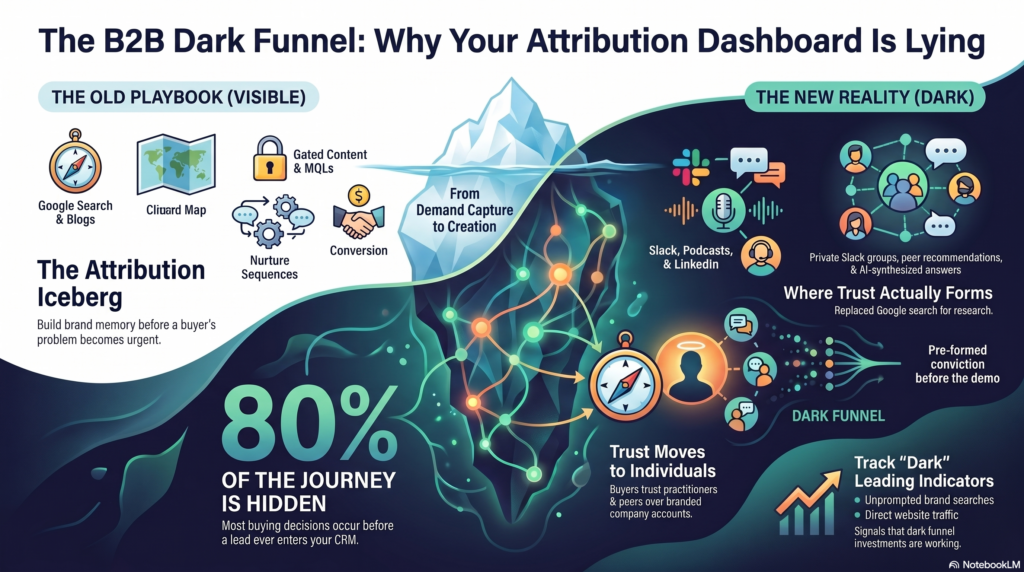
The funnel still exists. It’s just that most of it has moved somewhere you don’t have access to.
Your Buyer Decided Before You Knew They Existed
The shift in buyer behavior isn’t subtle, and it isn’t linear. It’s happening across four distinct layers, and each one cuts against the logic of the old funnel.
Buyers lurk for months before they engage
A VP of Sales evaluating Gong might follow Devin Reed’s content, watch replays of Gong’s webinars, read threads where Gong customers compare notes, and form a complete mental model of the product — without ever liking a post, filling out a form, or visiting the website.
The engagement metrics show nothing. The mental model is fully formed. When the time comes to evaluate revenue intelligence platforms, Gong is already in the room. This is the default behavior now, not the exception.
Opinions are pre-formed, not built on your site
Chris Walker’s Refine Labs built an entire business on making this argument publicly. His core point, repeated across hundreds of LinkedIn posts and podcast episodes, is that buyers arrive at your demo request form having already decided to buy.
The form isn’t where conviction is built. It’s where conviction is confirmed. Whatever happens after the form — the SDR call, the demo, the proposal — is a validation ritual for a decision already substantially made.
The implication is uncomfortable: your MOFU and BOFU content isn’t converting buyers. It’s closing buyers who converted themselves somewhere else.
AI search is quietly cannibalizing branded content
When a mid-market CFO asks ChatGPT “what’s the best spend management platform for a 200-person SaaS company,” the answer isn’t ten blue links. It’s a paragraph. That paragraph names two or three vendors, skips the rest, and the user treats it as a shortlist.
If you’re not named in that synthesized answer, you don’t exist for that buyer in that moment. Ranking on page one of Google matters less each quarter. The discovery layer has moved upstream, into systems that don’t attribute traffic back to you even when they reference you.
Trust has moved from brands to individuals
Buyers trust people now — specifically, practitioners and peers. A single recommendation in a private Slack group carries more weight than a case study on your website. David Cancel built Drift’s early rise on this exact insight: make the founders and the team the medium, let the brand benefit from the trust that individuals earn.
6sense has done the same through their own research and thought leadership on dark funnel behavior — research that happens to position them as the company most serious about the problem. Linear’s founders maintain an unusually strong public presence for a company of its stage, and that presence compounds into brand credibility no campaign could manufacture.
None of these behaviors shows up in your MQL report. All of them are shaping your pipeline.
The Dashboard Is Lying to You
Here’s the quiet crisis inside most B2B marketing teams: the metrics aren’t just incomplete. They’re actively misleading.
Last-click attribution gives credit to the final touchpoint before conversion. A buyer who spent eight months forming an opinion through a podcast, three LinkedIn newsletters, and a private community conversation shows up as “organic search” because they eventually typed your brand name into Google and clicked through.
The eight months of actual influence? Invisible. The ten seconds of branded search? Celebrated in the attribution report.
Multiply this across a pipeline, and you get a distorted picture of what’s working. Paid search looks like a hero because it captures intent that brand investment created. Retargeting looks efficient because it closes deals that community presence warmed up.
The content marketing team gets questioned for not driving “attributable pipeline” while the very content that built buyer conviction sits in podcasts and LinkedIn feeds with no UTM parameter attached.
Sales teams feel this gap constantly. Any enterprise AE will tell you that the best calls are the ones where the buyer opens with “we’ve been following you for a while.” Those buyers close faster, negotiate less, and churn less.
They’re the highest-quality pipeline the company has — and marketing has no idea where they came from, because the systems aren’t built to see the surfaces where those buyers formed their conviction.
The result is a marketing function optimizing for the tip of the iceberg while the ice underneath it silently melts or grows depending on whether anyone is investing there.
You can’t optimize what you can’t see. And most B2B teams have built their entire optimization loop around the visible 20 to 30 percent of the buying journey — the part that shows up in HubSpot, Salesforce, and Google Analytics. The other 70 to 80 percent — the part that actually decides whether you get shortlisted — sits in the dark funnel.
What the Dark Funnel Actually Is
The dark funnel is the collection of surfaces where B2B buying decisions actually form, none of which appear in your attribution model.
It’s concrete and specific. It’s the niche podcast a Head of Revenue Operations listens to on their commute. The LinkedIn feed where a competitor’s VP of Product posts twice a week about how they think about category.
The private Slack group where a peer mentioned your product had a rough onboarding experience. The Discord server where builders discuss tooling choices.
The AI-generated answer that named three vendors and left yours out. The conversation at a Saastr dinner where one person’s offhand recommendation becomes another person’s shortlist.
Different categories have different dark funnels, and the specifics matter. In design tooling, it runs through Figma’s Config conference, design Twitter, and creator-led YouTube channels. In developer tools, it runs through GitHub, Hacker News, podcast ecosystems like Changelog, and the public presence of founders — the reason Linear, Vercel, and Supabase have outsized brand equity relative to their marketing spend is that their founders and teams are deeply visible in the surfaces where their buyers live.
In productivity software, Notion built a creator ecosystem of template-makers, course creators, and YouTube reviewers that effectively became its top-of-funnel — an entire economy of people generating awareness the marketing team never paid for directly.
None of these surfaces are new. What’s new is their relative importance. Ten years ago, they were supplementary to a funnel anchored by search and branded content. Today, they are the funnel, and search and branded content are the validation layer that sits on top.
The dark funnel isn’t a failure of technology. You cannot instrument your way out of this. It’s a structural feature of how trust and attention work in markets where information is abundant, branded content is distrusted, and credibility is scarce. Buyers have developed immune responses to traditional marketing. They’ve built their own research ecosystems that route around it.
The question isn’t whether the dark funnel exists in your category. It does. The question is whether you’re present in it, and whether anyone on your team is measuring the right things to know.
Three Shifts the Winning Companies Have Already Made
The B2B companies winning in this environment aren’t trying to fix their funnel. They’ve made three conceptual shifts that most marketing teams haven’t internalized yet.
From Demand Capture to Demand Creation
The old funnel was built to capture demand that already existed. SEO, paid search, retargeting, comparison content — all of these work best when a buyer is actively looking. They’re capture plays. They harvest existing intent.
The problem is that in most B2B categories, intent is scarce and expensive. By the time a buyer is searching for “best CRM software,” they’ve already decided CRM is the category, already formed a shortlist, and you’re competing with every other vendor for a sliver of late-stage attention. Winning on capture means winning an auction.
Demand creation is different. It means showing up in a buyer’s awareness before they have intent — building the memory structures that make your brand the first one that comes to mind when a problem becomes urgent. This is what HubSpot did in the early inbound era: they didn’t capture demand for marketing automation, they created the conviction that inbound marketing was a category worth investing in, and then positioned themselves as the obvious answer.
Drift did the same thing with conversational marketing — a category they essentially named and then owned. Gong did it with revenue intelligence.
Demand creation is slower, harder to attribute, and more expensive to start. It’s also where the durable advantages get built. The companies still competing on capture are running on other people’s demand creation.
From Linear Funnels to Distributed Surfaces
There is no single buyer journey anymore. There are dozens of paths, and they run through surfaces your marketing team doesn’t fully control.
A buyer considering Notion might have first encountered it through a YouTube template creator, then seen a LinkedIn post from a productivity influencer, then read a thread on X about second-brain workflows, then watched a Notion-hosted webinar, then finally signed up.
Attribution will credit whatever the last touch was. The actual journey happened across five surfaces, none of which Notion owned directly, most of which were populated by a creator ecosystem Notion had cultivated over years.
This is the new shape of B2B top-of-funnel: distributed presence across the three or four surfaces where your buyers actually spend attention, not concentrated investment in a single acquisition channel.
Figma has done this with Config, their conference that doubles as a content machine, combined with a strong community presence in design circles. Gong has done this through a combination of founder visibility, executive LinkedIn presence, a podcast, and research reports that get widely shared.
The mistake most marketing teams make is trying to be everywhere and ending up thin everywhere. Distributed presence doesn’t mean diffuse presence. It means being genuinely substantial in the three or four places your buyers actually live, and accepting that you’ll be absent from the rest.
From Attribution Obsession to Brand and POV Investment
The hardest shift is philosophical. It means investing in things you can’t directly measure, because the things you can measure depend on them.
Attribution models punish brand investment. They reward the campaigns that close deals, not the years of consistent presence that made those deals closeable.
The logical conclusion, if you trust attribution, is to cut brand and pour more into performance. This is exactly what many B2B companies did during the post-2022 efficiency crunch. Many of them are now discovering that their pipeline has quietly degraded in ways the dashboard didn’t predict.
Chris Walker has spent years making this argument publicly, and the reason his content has traveled so far is that every B2B marketer who’s lived through a budget cycle recognizes the pattern. You cut brand.
Performance numbers hold for a quarter or two. Then the pipeline starts thinning at the top, deal cycles lengthen, and sales starts complaining about lead quality. By the time the correlation becomes visible, you’re six months into a recovery cycle.
Point-of-view content, founder visibility, community investment, and brand consistency are the inputs to the dark funnel. Demo requests, pipeline, and closed revenue are the outputs. Teams that obsess over outputs while underinvesting in inputs end up with funnels that look active but slowly run dry.
The companies getting this right — Gong, Notion, Linear, Figma, 6sense — treat brand as a compounding asset, not a discretionary line item. They invest when attribution can’t justify it, because they understand what attribution isn’t measuring.
What This Looks Like in Practice
None of this means abandoning demand capture. Paid search still works. SEO still matters. MQLs still close. The point is that these systems only work if the foundations underneath them are intact. Here’s what intact looks like operationally.
Audit the real discovery path
Interview recent customers. Not a survey — actual conversations. Ask them where they first heard of you, what they were reading or listening to in the months before they evaluated you, whose opinions mattered, and what made them shortlist you versus the alternatives. Do this across ten to fifteen customers and patterns will emerge.
Those patterns tell you where the dark funnel is active for your category. Most marketing leaders have never done this systematically, and they’re making investment decisions without the data.
Invest in individual visibility, not just brand accounts
Buyers trust people. If your CEO, VP of Product, or Head of Revenue is consistently sharing sharp, opinionated thinking in the surfaces your buyers inhabit, that compounds in a way a brand account never will.
This isn’t about founders becoming influencers. It’s about making your best thinkers publicly visible, because that’s what trust signals look like now. Gong’s team built enormous credibility through individual voices.
Linear’s founders have done the same. The pattern is consistent across the companies winning the dark funnel: named humans with public points of view.
Build point-of-view content, not just educational content
Most B2B content is indistinguishable. “10 ways to improve your email open rates.” “Why customer retention matters.” These posts get produced by every competitor and get remembered by no one. Point-of-view content takes a position. It says “here’s how we think about this, and here’s why the conventional wisdom is wrong.”
It creates intellectual fingerprints a buyer can recognize across surfaces. Educational content is table stakes. Point of view is what makes you memorable.
Treat brand search and direct traffic as leading indicators
When someone types your company name into Google unprompted, or navigates directly to your site, that’s a signal that the dark funnel worked for them. They encountered you somewhere, built enough curiosity to seek you out, and arrived with intent.
Most marketing teams track these numbers loosely, if at all. They should be tracked as closely as MQLs. They’re the cleanest visible signal that your invisible investments are working.
Use attribution directionally, not as an oracle
Attribution is useful for comparing campaigns in the same category — which ad creative performed better, which landing page converts higher. It is not useful for comparing brand investment to performance investment.
Protect investments in brand and community even when the attribution model can’t justify them, because cutting them is the fastest way to erode the foundation your visible pipeline depends on.
Show up in three surfaces consistently, not ten surfaces occasionally
Pick the surfaces where your buyers actually spend attention. For most B2B SaaS companies, that’s LinkedIn, one or two relevant podcasts, a community or two, and possibly a newsletter ecosystem. Commit to those. Be substantial. Skip the rest. Thin presence across many surfaces is worse than deep presence in a few.
The New Shape of B2B Marketing
The trajectory is already visible, and the next three to five years will widen the gap between companies that adapt and companies that don’t.
AI search will keep eating traditional search traffic. The share of B2B research conducted through ChatGPT, Perplexity, and the AI-generated answers now appearing at the top of Google will continue to grow.
Companies whose content is structured to be cited by these systems — with clear points of view, distinctive framing, and genuine authority — will show up in synthesized answers. Companies publishing undifferentiated educational content will disappear from the discovery layer entirely.
Founder and team brands will compound. The marketing value of a founder who has spent three years building a public point of view will become increasingly hard to replicate with paid acquisition.
This will create a talent dynamic where B2B companies compete not just for operators but for operators who can publicly represent the company. Some of this is already visible in how companies like Linear, Vercel, and Supabase recruit and deploy their teams.
Community will become more important than audience. An audience is a collection of people who consume your content. A community is a collection of people who talk to each other and happen to associate you with the conversation.
Notion, Figma, and Webflow have all built communities that function as distribution infrastructure. Building one takes years. Not building one makes every other marketing investment work harder.
Attribution will get less useful, not more. The more fragmented the discovery layer becomes, the less any attribution model can capture what actually drives buying decisions. The marketing teams that recognize this early will stop over-investing in attribution infrastructure and start investing in the things attribution can’t see.
Brand will stop being a discretionary investment. The companies that treat brand as a compounding asset will widen their moats. The companies that treat it as a line item to cut when times get tight will find that cutting it costs more than they saved.
Where Attention Actually Forms
The companies that grow in this environment share one characteristic. They stopped treating marketing as a system for processing buyers and started treating it as a practice of earning attention across surfaces they don’t fully control.
The funnel hasn’t disappeared. Most of it is simply invisible now. The teams that win aren’t the ones with the best-optimized pipeline or the cleanest attribution model. They’re the ones who show up consistently, with a real point of view, in the places where trust actually forms — long before a buyer types anything into a search bar.
The dark funnel doesn’t care about your attribution model. It runs on credibility and presence. And the only way to compete in it is to stop trying to engineer pipelines and start earning your place in the conversations where buyers actually decide.
